
It's 8:30 on a Tuesday evening. You're taking laundry out of the washing machine when you notice a strange smell coming from the storage room.
Curious, you walk in to investigate.
At first, you can't quite place it. Then you hear a faint gurgling sound coming from the floor drain. As you move closer, there's no mistaking it—that's where the smell is coming from.
Just then, someone upstairs flushes a toilet.
A few seconds later, water begins rising out of the floor drain, spreading across the concrete floor and creating a puddle of what can only be described as... well... sewage.
Your sewer is backing up.
So what now?
You know you need to call a sewer and drain specialist, but what do you actually ask for? Do you need your drain snaked? Does it need to be hydro jetted? Will you need to dig something up?
The answer depends on why your sewer is backing up in the first place.
The First Step Isn't Choosing a Service
The good news is that you don't need to know whether you need drain snaking or hydro jetting before you call.
In fact, trying to decide before anyone has looked at your sewer line is a bit like trying to diagnose why your check engine light is on without opening the hood.
Most sewer backup service calls begin with a conversation and a sewer camera inspection. Just like a visit to the doctor or a trip to the mechanic, the first step is understanding what's happening. A sewer and drain specialist will ask questions about what the homeowner has been experiencing before performing a sewer camera inspection to try to visually locate and confirm the cause of the backup. Once the problem has been identified, it's much easier to recommend the solution that's most likely to solve it.
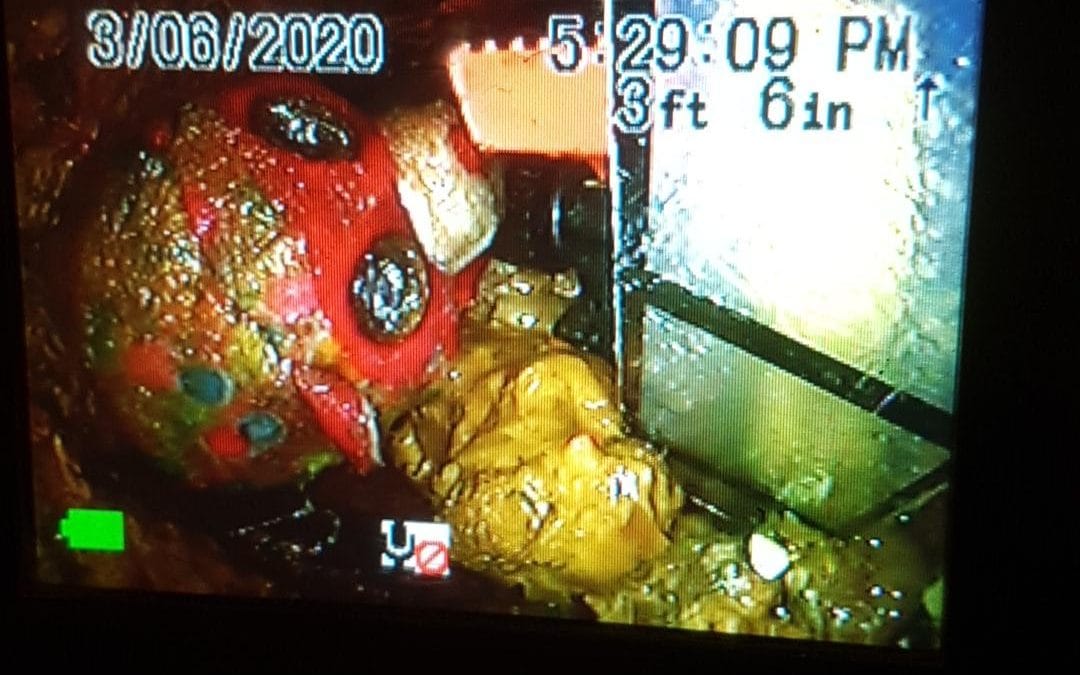
A sewer camera is a specialized waterproof camera that is fed through the sewer line, giving a live view of what's happening inside the pipe. It allows us to identify the cause of the blockage, whether that's tree roots, grease buildup, sludge, a collapsed section of pipe or something as simple as an object lodged in the line.
Just as importantly, a camera inspection tells us about the overall condition of the sewer line.
Is it an older clay pipe with cracked joints? Is there a section that's collapsed? Has part of the pipe developed a low spot where water and debris collect? Is the pipe in great shape and simply blocked by a one-time obstruction?
Once we know what we're dealing with, recommending the right solution becomes much easier.
What happens if the sewer camera inspection shows a blockage?
As the camera travels through the sewer line, everything appears normal until it suddenly stops. The image ahead is completely blocked by a mass of debris, and the technician can't see what's beyond it. At this point, the camera has done exactly what it was intended to do — it has located the source of the problem.
A blockage can be caused by a variety of materials, including toilet paper, hygiene products, grease, food waste or other debris that has become lodged in the sewer line. Sometimes the blockage forms on its own, while in other cases it's caused by an underlying problem such as tree roots, a belly in the pipe or a damaged section of sewer line.
The next step is usually to clear the blockage so the camera can continue the inspection. Once the obstruction has been removed, the technician can inspect the rest of the sewer line to determine whether the blockage was an isolated problem or a symptom of something more serious.
If the pipe is otherwise in good condition, clearing the blockage may be all that's required to restore normal flow. However, if the camera inspection reveals tree roots, grease buildup, a broken pipe or another issue farther down the line, the technician can recommend the most appropriate solution based on what the inspection uncovers.
That's why a sewer camera inspection is so valuable. Finding a blockage is only part of the process. It's equally important to determine why the blockage formed in the first place so the right solution can be recommended and future backups can be reduced.
Learn more about professional drain cleaning and sewer camera inspections.
What happens if the sewer camera inspection shows fat accumulation?
As the camera continues through the sewer line, the pipe doesn't appear broken and there are no tree roots blocking the way. Instead, the inside of the pipe is coated with a thick layer of grease, fat and soap residue. In some places, the buildup has narrowed the pipe so much that only a small opening remains for wastewater to pass through.
Fat accumulation is a common problem in kitchen drains. Although hot grease may go down the sink as a liquid, it cools as it travels through the sewer line and begins sticking to the inside of the pipe. Over time, more grease, food particles and other debris collect on the buildup, gradually restricting the flow of wastewater.
Unlike a simple blockage, grease usually coats the entire inside of the pipe rather than collecting in one location. A drain snake can often punch a hole through the buildup and restore flow, but it typically leaves much of the grease attached to the pipe walls.
That's where hydro jetting often becomes the better option. Using high-pressure water, hydro jetting scours the inside of the sewer line, removing grease and debris from the pipe walls and restoring much of the pipe's original diameter. If the camera inspection shows that the pipe is otherwise in good condition, hydro jetting can often provide a much more thorough cleaning than drain snaking alone.
The camera inspection is important because it confirms that grease is the problem and that the pipe is in suitable condition for hydro jetting. If the inspection reveals cracks, collapsed sections or other damage, a different solution may be recommended.
Learn more about hydro jetting and when it's the right solution for grease buildup.
What happens if the sewer camera inspection shows a belly in the sewer line?
As the camera moves through the sewer line, something looks different. Instead of flowing steadily downhill, the bottom of the pipe disappears beneath standing water. The camera enters the water and, for a few feet, visibility is limited before it eventually emerges and continues through the rest of the sewer line.
This is known as a belly, or a low spot, in the sewer line. Rather than maintaining a consistent slope toward the municipal sewer, part of the pipe has settled lower than the surrounding sections. As a result, wastewater doesn't completely drain away after each use.
A small amount of standing water isn't always a problem on its own. However, because water remains in the low spot, heavier materials travelling through the sewer line can settle there over time. Grease, toilet paper and other debris may gradually collect in the belly, eventually creating a blockage that causes the sewer to drain slowly or back up.
Unlike grease buildup or tree roots, a belly isn't something that drain snaking or hydro jetting can fix. Both methods may temporarily remove the debris that's collected in the low spot, but neither changes the shape or slope of the pipe. If debris continues to settle in the same location, the blockage is likely to return.
The sewer camera inspection helps determine how severe the belly is and whether it's actually contributing to the backup. Depending on its depth and the symptoms being experienced, the technician may recommend monitoring the line, scheduling periodic maintenance or repairing the affected section of sewer pipe to restore the proper slope.
Learn more about sewer line repairs and when a belly in the sewer line should be corrected.
What happens if the sewer camera inspection shows tree roots in the sewer line?
Tree roots are one of the most common causes of sewer backups, particularly in older neighbourhoods with clay sewer pipes. Although roots don't actively seek out sewer lines, they naturally grow toward moisture. Even a tiny crack or gap between sections of pipe can provide enough water and nutrients to attract them.
Once roots make their way inside the pipe, they continue to grow. Over time, they can catch toilet paper, grease and other debris flowing through the sewer line, gradually restricting the flow of wastewater. Eventually, the blockage can become severe enough to cause sewage to back up into the home.
If the roots are relatively minor and the pipe is otherwise in good condition, a sewer and drain specialist can often restore flow by cutting the roots with specialized drain cleaning equipment. In many cases, hydro jetting may also be recommended afterward to help remove smaller roots and clean debris from the pipe walls.
However, it's important to understand that neither drain snaking nor hydro jetting permanently solves a tree root problem. As long as the opening in the pipe remains, roots are likely to grow back.
If the camera inspection shows extensive root intrusion or significant damage to the pipe, repairing or replacing the affected section of sewer line may be the best long-term solution.
Learn more about tree roots in sewer lines and the options for removing them.
What happens if the sewer camera inspection shows a break in the sewer line?
As the camera continues through the sewer line, the image suddenly changes. Instead of a smooth, round pipe, the camera reveals a crack, a section that's collapsed or two pieces of pipe that have separated. In some cases, the camera may even be blocked from moving any farther because the pipe has completely caved in.
Broken sewer lines can happen for a number of reasons. Older clay pipes can crack or separate as they age, tree roots can force their way through joints and widen existing openings, and shifting soil or heavy loads above the pipe can cause sections of sewer line to collapse.
Unlike grease buildup or tree roots, a broken sewer pipe usually can't be solved by cleaning alone. While drain snaking may temporarily restore some flow in certain situations, and hydro jetting can remove debris from damaged sections of pipe, neither addresses the underlying problem. If the pipe has failed, the damage will remain.
The purpose of the sewer camera inspection is to determine not only that the pipe is damaged, but also how it's damaged. A small crack may require a different solution than a collapsed section of pipe or a joint that has pulled apart. Understanding the location and extent of the damage allows the technician to recommend the most appropriate repair.
Depending on what the inspection reveals, the solution may involve repairing a section of sewer line, replacing the damaged pipe or, in some cases, using a trenchless repair method if the pipe and surrounding conditions are suitable.
Learn more about sewer line repair and replacement options.
Need help finding the cause of a sewer backup?
If you're experiencing slow drains, repeated clogs or a sewer backup, a professional sewer camera inspection can identify what's happening inside your sewer line and help determine the most effective solution.
Whether the answer is drain snaking, hydro jetting, sewer repair or simply clearing a blockage, starting with an inspection helps ensure the problem is diagnosed correctly before any work begins.
Contact Phil Groves Sewer 911 to schedule a professional sewer camera inspection in Hamilton, Burlington, Oakville and the surrounding area.
Request a Service Call
We offer free quotes whenever possible. However, in some situations, a diagnostic assessment may be needed first (for example, a camera inspection) so that we can pinpoint the issue and provide an accurate quote, without any guessing.
Please Note: If this is an emergency, call 905-662-5852 for faster service.